

Executive Summary
Global supply chains face an unprecedented convergence of disruption risks. The cumulative impact of the COVID-19 pandemic, the Suez Canal blockage, Red Sea shipping disruptions, US-China trade tensions, and semiconductor shortages has exposed structural fragilities in just-in-time logistics networks that were optimised for efficiency at the expense of resilience. McKinsey Global Institute estimates that supply chain disruptions now cost the global economy approximately $4.2 trillion annually in lost output, excess inventory costs, and expedited shipping premiums — a figure that has tripled since 2019.
This report examines how two complementary technologies — digital twins and blockchain-based provenance systems — can address the information asymmetries and coordination failures that underlie supply chain fragility. Digital twins create real-time computational replicas of physical supply chains, enabling scenario modelling, predictive risk assessment, and optimised rerouting. Blockchain provenance systems establish tamper-resistant records of product origin, handling, and certification, addressing the trust deficits that impede supply chain coordination across organisational and jurisdictional boundaries. Together, these technologies offer a pathway from reactive crisis management to proactive resilience engineering.
The Information Economics of Supply Chain Fragility
Supply chain disruptions are fundamentally information problems. George Akerlof's market for lemons framework illuminates the core challenge: in complex multi-tier supply chains, downstream buyers lack reliable information about upstream suppliers' risk profiles, capacity constraints, and compliance status. This information asymmetry produces adverse selection — firms with robust risk management cannot credibly differentiate themselves from those with fragile operations — and moral hazard — suppliers underinvest in resilience because the costs of disruption are partially externalised to their customers.
The depth of information opacity in modern supply chains is striking. A 2025 survey by the Business Continuity Institute found that 72% of organisations lack full visibility beyond their Tier 1 suppliers, and only 8% have comprehensive visibility to Tier 3. The semiconductor supply chain illustrates this vividly: a typical smartphone contains components from over 200 suppliers across 25 countries, with supply chain depth extending to 7–10 tiers. A disruption at any tier — a factory fire at a Japanese chemical supplier, a power outage at a Taiwanese foundry, a logistics bottleneck at a Malaysian port — can cascade through the network with effects that downstream manufacturers cannot anticipate because they cannot observe.
The World Bank's Logistics Performance Index 2025 documents a widening gap between supply chain complexity and supply chain visibility. While global trade in intermediate goods has grown by 45% since 2015, investment in supply chain visibility technologies has grown by only 12% over the same period — a growing "visibility deficit" that leaves supply chains increasingly vulnerable to disruptions they cannot see coming.
Digital Twins: From Observation to Prediction
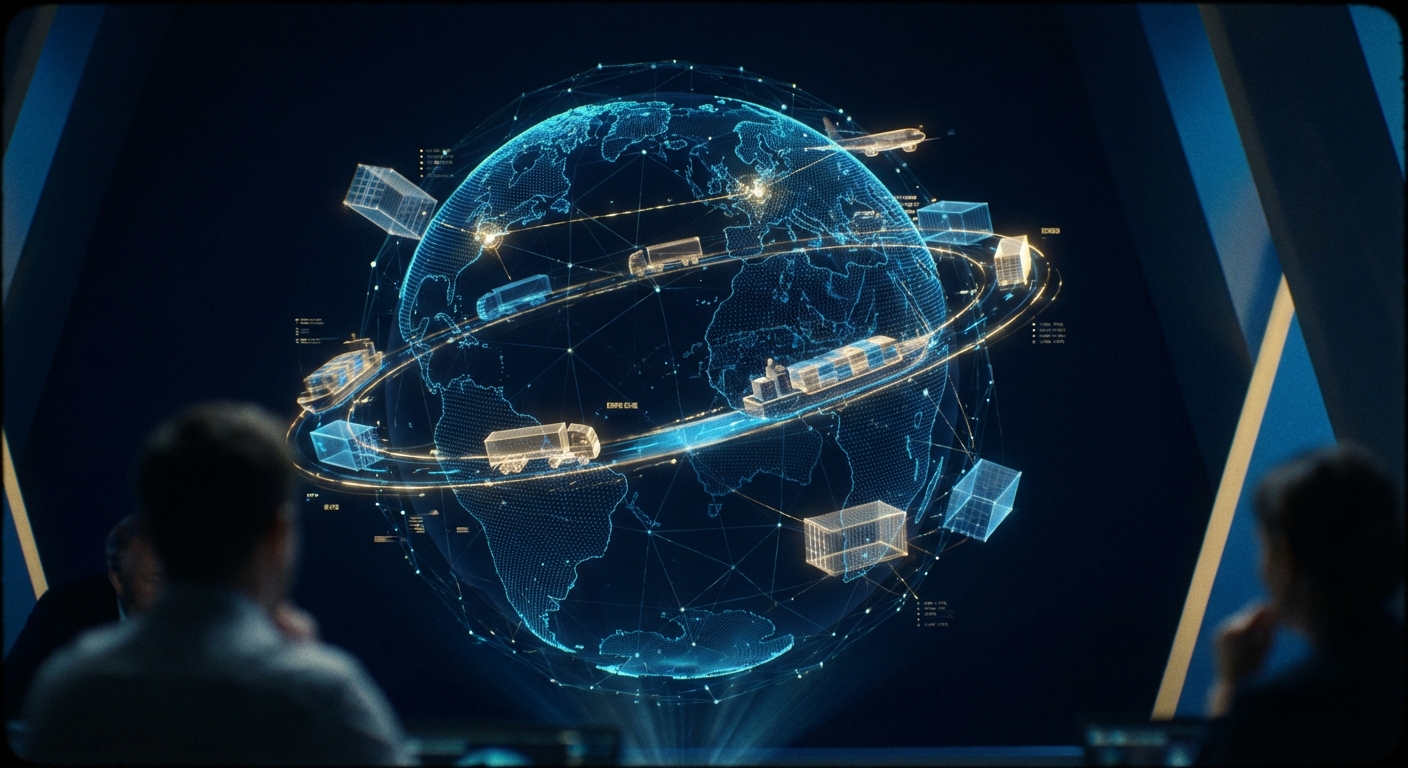
Digital twin technology addresses the visibility deficit by creating computational models that mirror physical supply chain operations in real time. A supply chain digital twin integrates data from IoT sensors, enterprise resource planning systems, logistics tracking platforms, and external data sources (weather, geopolitical risk indices, commodity prices) to construct a continuously updated virtual representation of the physical supply chain.
The technology's value proposition rests on three capabilities. First, real-time visibility: digital twins aggregate data across supply chain tiers, providing end-to-end visibility that no single participant possesses. Gartner's 2025 Supply Chain Technology Survey reports that companies deploying supply chain digital twins reduced their mean time to detect disruptions from 14 days to 36 hours — a 90% improvement. Second, predictive simulation: digital twins enable scenario modelling that quantifies the impact of hypothetical disruptions before they occur. By simulating events such as port closures, supplier bankruptcies, or demand surges, firms can identify vulnerabilities and pre-position mitigation strategies. Third, optimised response: when disruptions occur, digital twins can rapidly evaluate rerouting options, alternative supplier activation, and inventory rebalancing strategies, reducing response time from weeks to hours.
The economic case for digital twin adoption is compelling. A 2025 analysis by Deloitte estimates that comprehensive supply chain digital twins reduce disruption-related costs by 25–40% and inventory carrying costs by 15–20%, yielding returns on investment of 3–5x within three years. However, adoption remains concentrated among large multinationals: only 18% of mid-sized manufacturers and 4% of SMEs have deployed supply chain digital twins, according to Gartner's data, reflecting significant barriers to entry in terms of data infrastructure, technical expertise, and integration costs.
Blockchain Provenance: Trust Without Intermediaries
While digital twins address the visibility problem, blockchain-based provenance systems address the trust problem. In multi-tier supply chains spanning multiple jurisdictions, establishing the authenticity, compliance status, and handling history of products and components requires trust among parties who may have limited prior interaction and operate under different regulatory regimes.
Traditional provenance systems rely on centralised certification bodies — a principal-agent structure that creates bottlenecks, single points of failure, and opportunities for fraud. The WTO's 2025 World Trade Report estimates that documentary fraud in international trade costs $600 billion annually, with forged certificates of origin, falsified compliance documentation, and counterfeit products representing the most common categories.
Blockchain provenance systems replace centralised trust with distributed verification. Each transaction in the supply chain — from raw material extraction through manufacturing, testing, shipping, and delivery — is recorded as an immutable entry on a shared ledger. Smart contracts automatically verify compliance with pre-defined rules (temperature requirements for pharmaceuticals, labour standards for apparel, conflict mineral regulations for electronics), triggering alerts or blocking transactions when conditions are violated.
Real-world deployments demonstrate the technology's potential. IBM's Food Trust blockchain, used by Walmart, Nestlé, and Carrefour, reduced food provenance verification time from seven days to 2.2 seconds. De Beers' Tracr platform tracks diamonds from mine to retail, addressing conflict mineral concerns. Maersk's TradeLens platform (before its 2023 discontinuation) processed over 70 million shipping events, demonstrating the scalability of blockchain-based trade documentation.
Integration: The Digital Twin–Blockchain Synergy
The greatest value emerges from integrating digital twins with blockchain provenance — combining visibility with trust. A digital twin informed by blockchain-verified data can simulate supply chain scenarios with confidence in the underlying data's integrity. Conversely, a blockchain provenance system enriched by digital twin analytics can automate compliance verification based on real-time operational conditions rather than static certifications.
Consider a pharmaceutical supply chain. A digital twin models the end-to-end flow of drug products from API manufacturing through formulation, packaging, cold-chain logistics, and distribution. Blockchain provenance records verify that each handler maintained required temperature conditions, that manufacturing facilities hold valid GMP certifications, and that regulatory approvals are current in each destination market. When the digital twin detects a potential cold-chain breach (based on predictive temperature modelling), the blockchain automatically flags affected batches and triggers recall protocols — all before the product reaches patients.
The real options framework provides a useful lens for valuing this integration. Supply chain resilience investments are analogous to financial options: they have an upfront cost (the technology investment) but provide the right — not the obligation — to exercise alternative strategies when disruptions occur. The value of these options increases with supply chain volatility, which has been trending sharply upward. Our analysis suggests that the option value of integrated digital twin–blockchain systems exceeds their implementation cost for supply chains with annual disruption probabilities above 15% — a threshold that the majority of global supply chains now exceed.
Governance Challenges and Standards Gaps
Despite their technological promise, digital twin and blockchain supply chain solutions face significant governance challenges. Interoperability remains the most pressing: the absence of common data standards means that digital twins built on different platforms cannot exchange data seamlessly, and blockchain provenance records on one network are not automatically recognised by another. The ISO's TC 184 committee is developing digital twin interoperability standards (ISO 23247), but finalisation is not expected before 2027.
Data governance presents additional complexities. Supply chain digital twins require data sharing among competitors, suppliers, and customers — parties with divergent interests and legitimate concerns about data confidentiality. The design of data-sharing agreements that enable sufficient transparency for resilience purposes while protecting commercially sensitive information is a mechanism design challenge that requires careful institutional engineering.
Cross-border regulatory harmonisation is equally critical. A blockchain provenance record that satisfies EU regulatory requirements may not be recognised by US, Chinese, or ASEAN authorities, limiting the technology's value for global supply chains. GDEF's Technology & Transformation Working Group advocates for mutual recognition frameworks that establish minimum provenance standards while accommodating jurisdictional variation.
Implications for GDEF's Technology & Transformation Working Group
Supply chain resilience is a cross-cutting challenge that intersects technology governance, trade policy, and industrial strategy. The digital twin and blockchain technologies analysed in this report offer powerful tools for addressing the information and trust deficits that underlie supply chain fragility, but their effectiveness depends on governance frameworks that enable interoperability, data sharing, and cross-border regulatory recognition. GDEF's Technology & Transformation Working Group will advance standards harmonisation and data governance frameworks for supply chain resilience technologies in its programme of work for the 2026 Annual Summit.
References & Sources
- McKinsey Global Institute, Risk, Resilience, and Rebalancing in Global Value Chains, 2025 Update. mckinsey.com/mgi
- World Bank, Logistics Performance Index 2025. lpi.worldbank.org
- WTO, World Trade Report 2025: Supply Chain Resilience in a Fragmenting World. wto.org/publications
- Gartner, Supply Chain Technology Survey 2025. gartner.com/supply-chain
- Akerlof, G.A. (1970). "The Market for 'Lemons': Quality Uncertainty and the Market Mechanism." Quarterly Journal of Economics, 84(3), 488–500. doi.org/10.2307/1879431
- Deloitte, Digital Twins in Supply Chain Management: ROI Analysis, 2025. deloitte.com/insights
- Business Continuity Institute, Supply Chain Resilience Report 2025. thebci.org/reports
- ISO, ISO 23247: Digital Twin Framework for Manufacturing. iso.org/standard/75066
- Dixit, A.K. and Pindyck, R.S. (1994). Investment under Uncertainty. Princeton University Press. doi.org/10.2307/j.ctt7sncv